
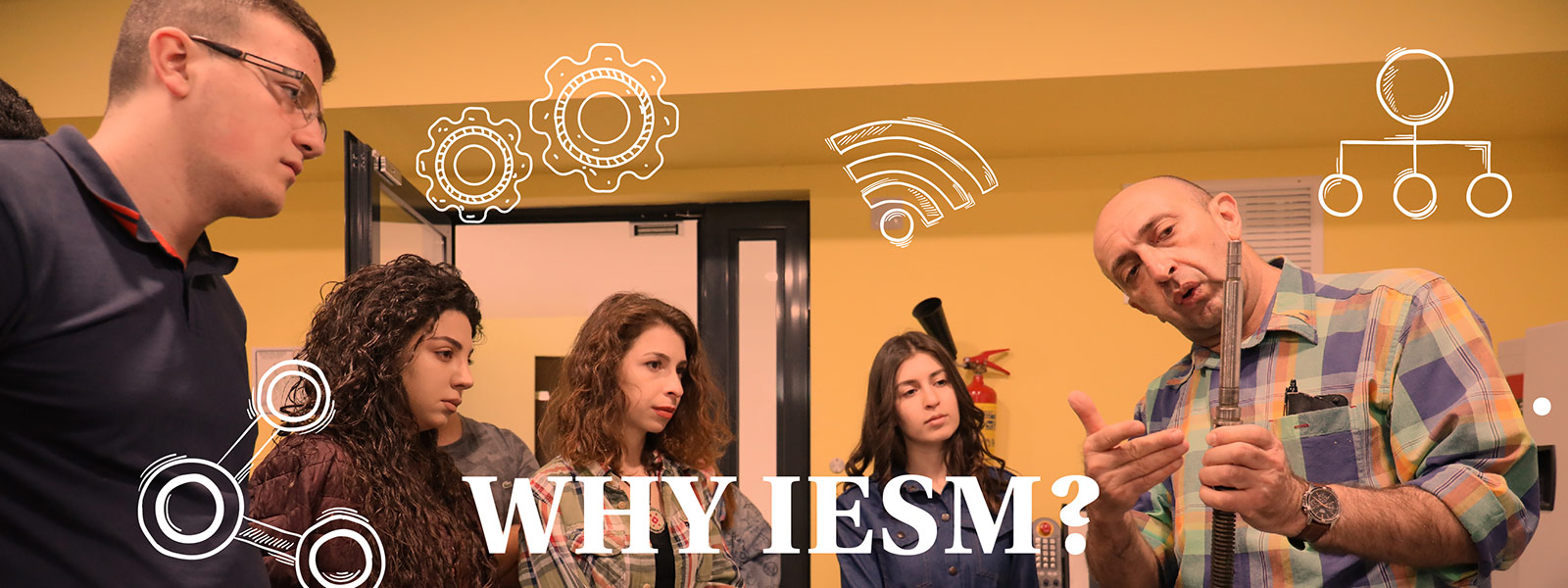
 What drives value creation in any industry? Take a closer look at the basics of value creation in any business and what you see are operations and processes that need to get more effective, faster, organized, perfectly planned. How quality is standardised and assured and logistics are built to ensure uninterrupted and optimal production and shipment of goods and services.
The two-year Industrial Engineering and Systems Management Program, offered by the Akian College of Science & Engineering, offers a unique set of skills and knowledge, that are widely used in any industry to introduce data driven analysis and optimization of operations to increase efficiency of production systems by finding optimal solutions to a wide array of business problems.
IESM Program Curriculum – what’s in it for you?
We offer six core foundational courses that provide students both intellectual depth and practical skills in Operations Research, Quality Assurance and Management, Simulation of IE Systems, Engineering Economics, Analysis and Design of Data Systems, and Production System Analysis.
In addition ME IESM offers a great variety of elective courses that students choose from based on the concentration they decide to pursue:
Learn More about the concentrations and courses we offer
Why IESM
Here are 3 reasons why students choose ME in IESM:
Our Graduates Create Maximum Results with Minimum Resources

Being problem solvers in business process optimization, IESM professionals are educated to:
- Delve into basics of any business
- Connect business and technology
- Optimize complex processes
- Reduce waste, time and resource consumption
- Increase quality and productivity
98% of IESM graduates get employed within the first 3 months
Unique skills, best practices and fundamental knowledge offered by IESM grows you into a flexible employee with:
- Multi-discipline approaches skills,
- Engineering thinking and methods,
- Data driven analytical mindset,
- Design and management acumen
- Effective and intelligent business operation expertise
Learn about IESM career opportunities here.
Most of Industries Hunt after IESM Talent
IESM graduates are equipped with in-depth understanding of challenges and growth mindset in a wide range of industries.
Knowledge + creative mind + handy skills is a definition of IESM professional and a must for almost any industry.
Industries where IESM alumni take leadership positions
- Healthcare, Hospitality
- Software Engineering and IT, Telecom, Utility.
- Management and Technology Consulting, Finance
- Production, Agriculture
- Construction, Transport, Mining